
Types of Business Entity
Published on
February 01, 2026
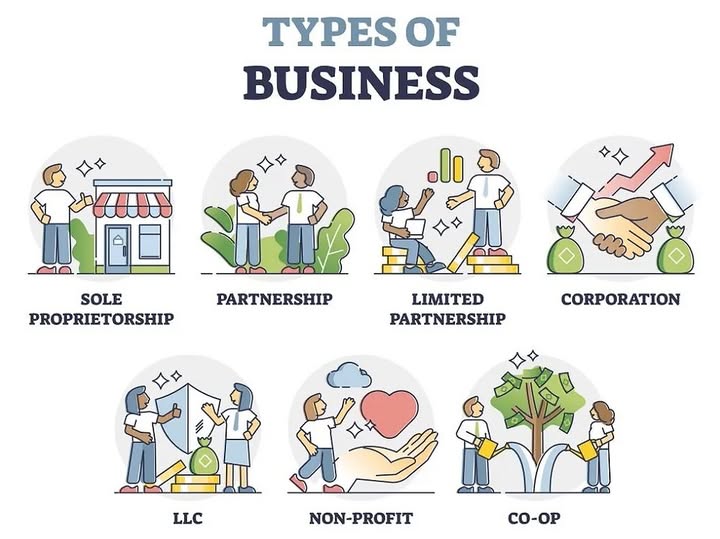
Types of Business Entity
There are so many types of business entity. Let’s know more about these in details.
Individual and partnership-based entities
Sole Proprietorship: A business owned and run by Single person, which is easy to start but has unlimited liability for the owner. It is the simplest and cheapest business structure to start, typically requiring only minimal formal registration and no special legal process, although specific licenses or certifications may be necessary depending on the industry type.
Key features
One owner: The business is owned, managed, and controlled by a single person.
No legal separation: The owner and the business are considered the same entity in the eyes of the law.
Unlimited liability: The owner is personally responsible for all business debts and liabilities. Creditors can seize the owner's personal assets to repay business debts.
Easy to form and close: It is the simplest business to start, requiring little formal process. The business can be easily closed by the owner.
Full control: The sole proprietor has complete control over all business decisions and operations.
Full profits: The owner receives all profits generated by the business.
Partnership: A business structure with two or more owners who agree to share in the profits or losses of the business. Key details include the names and addresses of the firm and its partners, the profit and loss sharing ratio, each partner's capital contribution, and their respective rights, duties, and obligations. The agreement also covers operational specifics like management, dispute resolution, and rules for new partners, retirement, or dissolution.
The maximum number of partners in a partnership firm is 50. This limit is set by the Central Government under the Companies (Miscellaneous) Rules, 2014, which prohibits associations of more than 50 persons from carrying on a business for profit unless registered as a company or formed under another law.
If a partnership firm exceeds 50 partners, it must be registered as a company.
This limit is a key provision of the Companies Act, 2013, not the Indian Partnership Act, 1932 itself.
Partnership agreement details
Basic information: The name and address of the business, along with the names and contact information of all partners.
Financial details: The profit and loss sharing ratio, each partner's capital contribution, and interest rates on capital, loans, and drawings.
Operational terms: The nature of the business, the duration of the partnership, and how assets and liabilities are handled upon dissolution.
Partner roles and responsibilities: The specific rights, duties, and obligations of each partner. This also includes rules for the admission of new partners or the retirement or death of existing partners.
Remuneration: Details on any salaries or commissions to be paid to partners.
Dispute resolution: The method for settling disagreements that may arise among partners.
Key Notes:-
Prevent misunderstandings:
A written agreement prevents confusion and disputes by clearly defining the terms of the partnership.
Formalize the relationship:
The partnership deed serves as a formal record of the arrangement, which is especially useful for registration purposes.
Establish roles and responsibilities:
It clarifies who is responsible for what, including management, operations, and financial contributions.
Limited Liability Partnership (LLP): A hybrid structure that combines the flexibility of a partnership with the limited liability protection of a company. where partners have limited liability, meaning their personal assets are protected from business debts. It is a separate legal entity from its partners and can own property and enter contracts in its own name. This structure is popular with professionals and small to medium-sized businesses seeking flexibility and minimal compliance requirements. There is no maximum limit on the number of members (partners) in a Limited Liability Partnership (LLP) in India. An LLP must have a minimum of two partners to be formed.
Key features of an LLP
Limited liability: Partners are not personally liable for the debts or obligations of the business. Their liability is limited to their agreed-upon contribution to the LLP.
Separate legal entity: An LLP is a legal entity separate from its partners, with perpetual succession, meaning a change in partners does not affect the LLP's existence.
Flexibility: It allows for operational flexibility through an agreement between partners, similar to a traditional partnership.
Partner liability: A partner is not responsible for the misconduct or negligence of another partner.
Governing laws and requirements
Legal framework: LLPs are governed by specific acts, such as the Limited Liability Partnership Act, 2008 in India.
Minimum partners: A minimum of two partners is typically required to form an LLP.
Designated partners: There must be at least two designated partners, with at least one being a resident in India.
LLP agreement: A formal agreement is necessary to define the rights, duties, and responsibilities of the partners and is required for incorporation.
Company:-
A company is a legal body created to do business and make profit. It can be set up in different ways, like sole proprietorships,partnerships,private companies, or public companies, each with its own legal and financial setup. This guide explains how companies work, the differences between them, and how to start one. Understanding these details helps entrepreneurs and investors make better decisions for business growth and success.
A company is a separate legal body formed by law for business or trade. it allows a group of people to work together for a common goal, usually to make a profit. A company is treated like a person- it can make contracts, own property, take legal action, and owe money, all on its own, not in the name of its owners. This idea of a “separate legal entity”. means the personal belongings of the owners are protected from the company’s debts and problems. Many new companies rely on a startup business loan to get the funds needed to grow and succeed.
How does a company work:-
A company operates as a separate legal entity from its owners, managed by a board of directors elected by shareholders. It raises capital by issuing shares or debt. The board sets policies and oversees management, which runs day to day operations. Companies produce goods or services for profit, reinvesting earnings or distributing dividends to shareholders.
They comply with regulatory requirements, including financial reporting and taxes. Decisions are made through structured governance processes, ensuring accountability and strategic alignment. Companies can expand by acquiring other businesses, entering new markets, or innovating products, aiming for sustainable growth and increased shareholder value. Many small and medium enterprises rely on an Meme loan to support such growth initiatives effectively.
Types of Company based on their structures:
Private limited company
A private limited company in India is a privately held business with limited liability for its shareholders, limited to the number of shares they hold. Governed by the Companies Act, 2013, it requires a minimum of two directors and two members, with a maximum of 200 members. Its shares are not freely transferable to the public and require approval to transfer between existing members. This structure is popular for small and medium-sized businesses due to its legal distinction from owners, enhanced credibility, and flexibility.
Key features
Limited liability:
A shareholder's liability is limited to their stake in the company.
Separate legal entity:
The company is a distinct legal entity separate from its owners, ensuring perpetual existence regardless of changes in ownership.
Restricted share transfer:
The right to transfer shares is restricted, and shares cannot be offered to the public for subscription.
Membership limits:
A private limited company must have a minimum of two members and a maximum of 200 members (excluding one-person companies).
Director requirements:
It requires a minimum of two directors, at least one of whom must be an Indian resident.
Advantages
Credibility and professional image: It is often perceived as more credible and professional than other business structures, which helps in attracting clients, employees, and investors.
Access to capital: It can raise capital by issuing shares to investors.
Flexibility: It offers a flexible business structure and is suitable for professional management.
Tax benefits: It is eligible for various tax benefits and incentives.
Formation and compliance
Formation:
A private limited company is registered with the Ministry of Corporate Affairs (MCA) by filing the SPICe+ form.
Documentation:
The process requires obtaining a Digital Signature Certificate (DSC) for directors, a Director Identification Number (DIN), and drafting the Memorandum of Association (MoA) and Articles of Association (AoA).
Annual compliance:
The company is required to file annual income tax returns and submit its audited financial statements and annual returns to the Registrar of Companies (ROC).
Public Limited Company
A public limited company (PLC) in India is a company that can sell its shares to the general public, typically through a stock exchange. These companies are governed by the Companies Act, 2013, must have a minimum of seven shareholders and three directors, and are subject to stringent regulations for corporate governance and transparency. They are a popular structure for large businesses seeking to raise substantial capital for expansion.
Key characteristics
Public share offering: A defining feature is the ability to sell shares to the public through an Initial Public Offering (IPO) or via the stock market.
Separate legal entity: It is a distinct legal entity from its owners.
Limited liability: Shareholders have limited liability, meaning their personal assets are protected from the company's debts.
Governance and regulation: Governed by the Companies Act, 2013, PLCs must comply with strict rules and disclose financial information to protect investors.
Shareholder and director requirements: A minimum of seven shareholders and three directors are required for incorporation.
How they raise funds
Public share issue: They can raise capital by issuing shares to the general public, which can then be traded on stock exchanges like the Bombay Stock Exchange (BSE) or the National Stock Exchange (NSE).
Debentures: They can also raise funds by issuing debentures.
One Person Company:
A One Person Company (OPC) in India is a private limited company with just one member, introduced by the Companies Act, 2013. It combines the limited liability and separate legal entity status of a company with the single-person ownership of a sole proprietorship, offering a formal corporate structure for solo entrepreneurs. Key features include requiring a nominee at registration, a minimum of one board meeting every six months, and specific compliance and naming requirements, such as mentioning "(OPC)" after the company name.
Key features and requirements
Structure and ownership:
An OPC is a private limited company with only one member, who is also the sole shareholder. A natural person who is an Indian citizen and resident can incorporate an OPC.
Nominee:
The member must appoint a nominee when registering the company, who will become the new member in the event of the original member's death or incapacity.
Legal status:
It is a separate legal entity, meaning the company's liabilities do not affect the personal assets of the sole member. It also has perpetual succession, ensuring continuity.
Naming:
The words "One Person Company" or "(OPC)" must be included in brackets after the company's name on all official documents and signage.
Board meetings:
At least one board meeting must be held every six months.
Restrictions:
Minors cannot be members or nominees. The company is barred from engaging in non-banking financial investment activities.
Conversion:
An OPC must convert to a private limited company or a public limited company if its paid-up share capital exceeds ₹50 lakh or its average annual turnover exceeds ₹2 crore.
Advantages
Limited liability:
Protects the owner's personal assets from business liabilities.
Corporate image:
Provides a more professional and credible image than a sole proprietorship.
Ease of transfer:
The ownership transfer is relatively simple compared to other company structures.
Reduced compliance:
Has a lower compliance burden compared to traditional private limited companies.
Subsidiary Company
A subsidiary is a company that is completely or partially owned and controlled by a parent or holding company. The parent company typically holds a majority of the subsidiary's voting stock, giving it significant influence over its operations and decisions, though the subsidiary remains a separate legal entity. Subsidiaries are often established or acquired to allow a parent company to diversify its business, enter new markets, or gain tax benefits.
Key characteristics
Ownership and control: A parent company must own at least 50% of a subsidiary's stock to control it. If a company owns 100% of a subsidiary, it is called a "wholly owned subsidiary".
Separate legal entity: A subsidiary is a distinct legal entity from its parent, with its own management team, employees, and business model. This separation can protect the parent company from the subsidiary's liabilities.
Strategic direction: While operating independently, a subsidiary's strategic direction is set by the parent company. This can include decisions about board structure and major transactions.
Consolidated financials: The financial results of a subsidiary are typically consolidated with those of the parent company.
Why companies use subsidiaries
Diversification: A parent can use subsidiaries to expand into new markets or industries without taking on excessive risk for the core business.
Risk management: By separating a high-risk venture into a subsidiary, the parent company can limit its exposure to financial or legal liabilities.
Tax benefits: Setting up subsidiaries can provide tax advantages.
Operational efficiency: Subsidiaries can be used to operate different business lines or brands separately, which can lead to greater efficiency and focus
Subsidiaries of Indian parent companies
Tata Steel subsidiaries: Tata Steel operates several subsidiaries, such as Tata Steel Utilities and Infrastructure Services Limited, The Indian Steel & Wire Products Ltd., and Adityapur Toll Bridge Company Limited.
Tata Motors subsidiaries: Tata Motors has numerous subsidiaries, including TAL Manufacturing Solutions Ltd., Tata Motors Finance Ltd., and Jaguar Land Rover Plc, according to its filings.
Tata Consultancy Services (TCS): A subsidiary of Tata Sons, the holding company of the Tata Group,
Non-Profit organizations (NPO)
A non-profit organizations registered under the Section 8 companies Act, 2013, with the primary goal of promoting objectives like education, charity, science, social welfare, and environmental protection. Key features include reinvesting any profits into the company's objectives rather than distributing dividends to members, strict legal compliance, and tax benefits under certain Income Tax Act sections.
Purpose and objectives
Charitable purpose: To promote arts, commerce, science, research, education, sports, charity, social welfare, religion, or environmental protection.
Profit usage: Any income or profit generated must be used exclusively to further the company's non-profit objectives, not for paying dividends to members.
Legal and operational aspects
Legal structure: They function as non-governmental organizations (NGOs) but with a more structured, corporate, and transparent framework.
Limited liability: Like other companies, they are separate legal entities and provide limited liability to their members.
Governing law: They are governed by Section 8 of the Companies Act, 2013, and must comply with its rules and regulations.
Board of directors: A minimum of two members is required, with no upper limit, and the board of management can be a board of directors or a managing committee.
Benefits and advantages
Credibility: The stringent compliance framework increases credibility with donors and other stakeholders compared to some other NGO structures.
Tax benefits: They can benefit from tax exemptions under sections like 12(A) and 80(G) of the Income Tax Act.
Increased trust: The corporate structure and transparency can foster greater trust among stakeholders, as it follows stricter compliances post-registration.
Examples of Section 8 companies
Infosys Foundation
Reliance Foundation
Tata Trusts
The Akshaya Patra Foundation
WaterAid India